Understanding Value in Betting
When we talk about finding value in the betting markets, we are referring to the process of identifying bets that have better odds than they realistically should. This does not necessarily mean only picking winners but finding bets where the probabilities of an outcome are better than the odds imply. This concept is crucial because consistent profits in betting are made not by simply betting on winners, but by making bets where the odds are in your favor over time.
To comprehend this further, it’s essential to grasp the relationship between odds and implied probabilities. Odds offered by bookmakers reflect the likelihood of a particular event occurring, translated into monetary terms. For example, if a bookmaker offers odds of 4.00 for a particular horse to win a race, this implies there is a 25% chance the horse will win (1 divided by 4.00). If you believe the chance of the horse winning is greater than 25%, this represents a value betting opportunity.
Different Formats of Odds
Before delving deeper into how to find value, understanding the different formats of odds used in betting is necessary. Mainly, there are three types of odds formats:
1. Decimal odds: Common in Europe, Canada, and Australia, these are straightforward to understand. The figure quoted represents the total payout rather than the profit. For example, decimal odds of 4.00 mean you receive $4 back for every $1 you wager, including your initial stake, if your bet wins.
2. Fractional odds: These are traditionally used in the UK and Ireland. For example, if you see odds of 3/1 (read as “three to one”), you can win three dollars for every one dollar bet, plus your original dollar back.
3. American odds: These can be either positive or negative. GGBET AR Positive odds show how much profit you would make on a $100 bet, while negative odds show how much you need to bet to make $100 in profit.
Calculating Implied Probability
To identify value, you first need to convert bookmaker odds into implied probabilities. For decimal odds, the formula is quite simple: Implied Probability = 1 divided by Decimal Odds. For example, odds of 4.00 have an implied probability of 1 / 4.00 = 0.25 or 25%.
When you have calculated the implied probability, you need to assess whether this reflects the true likelihood of the event happening. This assessment comes from your own analysis or from insights that you gather which may include anything from statistical analysis, historical performance, or other relevant factors such as weather conditions in a sports event.
Analytical Approaches to Finding Value
Finding value requires a solid foundation in analytical approaches, primarily focused on sporting statistics and performance analytics. Here are a few methods:
– Statistical analysis: This involves looking at a wide range of statistics, such as past performance, head-to-head records, current form, and more. Tools like databases and sports analytics software can provide an edge in understanding patterns that are not immediately obvious.
– Expert opinion and insider knowledge: Sometimes, information is not all available via statistics. Expert opinions, from those who have spent a significant amount of time observing and analyzing particular sports or leagues, can provide insights that are not quantifiable but are incredibly valuable.
– Technical tools such as machine learning models: These can analyze large data sets and reveal probabilities that may not be considered by traditional methods or bookmakers.
Practical Steps in a Betting Value Strategy
In practical terms, a bettor seeking to exploit betting for profit through value betting should follow several steps:
1. Data collection: Gather as much relevant data as possible. This could be performance data, injuries, weather conditions, and other variables that affect the outcome of the event.
2. Data analysis: Apply statistical tools to analyze the data. Use this analysis to estimate your own probabilities for the outcome(s).
3. Comparison: Compare your estimated probabilities with the bookmaker’s implied probabilities.
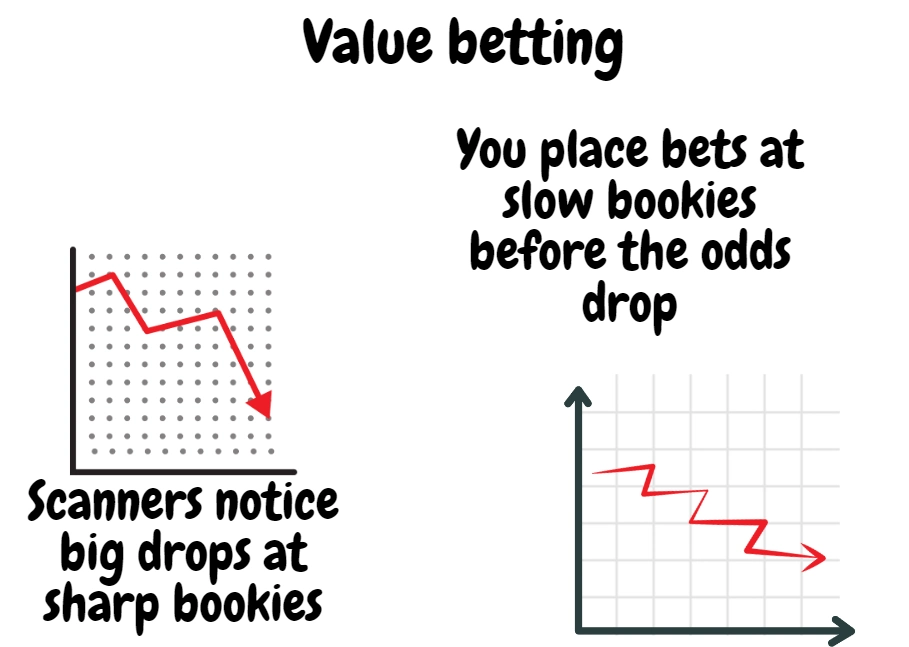
4. Bet selection: Only place bets where your calculated probability of an event happening is higher than the implied probability reflected in the bookmaker’s odds.
5. Record and manage: Keep detailed records of all bets placed, the thought process behind each bet, outcomes, and profitability. This review will help refine methods and strategies over time.
Mitigating Risks in Value Betting
While value betting can be profitable, it also comes with risks like any form of gambling. Here are tips to mitigate these risks:
– Stake sizing: Use a betting bankroll and a staking plan. This can be a flat betting approach or a percentage of bankroll strategy, where you only bet a small portion of your bankroll on each wager.
– Diversification: Don’t put all your eggs in one basket. Spread your bets across various sports and events to mitigate the risk of a single bad outcome affecting your overall profitability.
– Continuous learning and adaptability: Betting markets evolve, and odds adjust. Continually refine your analysis techniques and stay informed about changes in the sports you are betting on.
Value betting is not about quick wins but about making calculated, informed decisions that give you a mathematical edge over time. With discipline, the right analytical tools, and an effective risk management strategy, value betting can be a profitable endeavor.
No Responses